
Headless Content Management
- Last Modified:
- 19 Aug 2026
- User Level:
- Terminalfour Developer
Headless describes a content management approach where the system used to create and manage content is not necessarily connected to the technology used to display that content.
In simple terms, a headless CMS manages what your content is, but doesn't dictate where or how that content is displayed.
This gives organizations more freedom to use their content across websites, applications, mobile apps, digital signage, personalization platforms and other digital experiences.
And importantly, Terminalfour can be used as a headless CMS.
What does "headless" mean?
The term comes from the idea of separating the "head" from the "body" of a CMS.
In a traditional CMS, the system often does both jobs:
- It stores and manages your content.
- It determines how that content is presented to visitors.
- It generates the pages that visitors see.
A headless CMS separates these responsibilities.
The CMS remains responsible for managing content, while another application or website is responsible for presenting it.
Think of it like this:
Traditional CMS
Content → CMS → Web page
Headless CMS
Content → CMS → "API" → Website / App / Other digital experience
The CMS provides the content in a structured format, such as JSON. A separate application can then use that content however it needs to.
Terminalfour gives you the flexibility to do both approaches. You can use Terminalfour to control the presentation of content on your website while also providing a way to access structured data to be consumed by other applications.
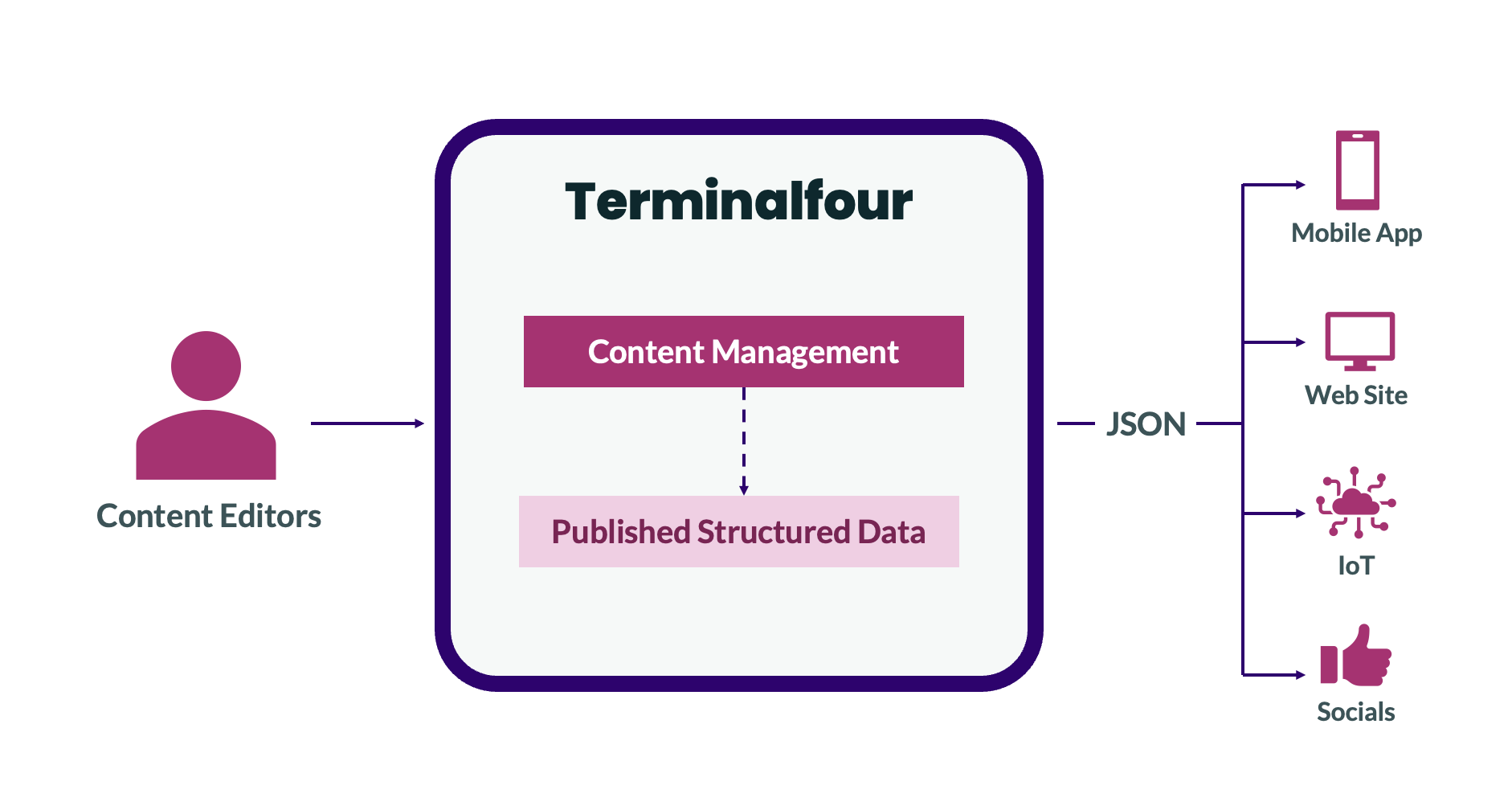
You don't need to be a developer to benefit from this approach. For content editors, the experience of creating and managing content can remain largely the same.
Why use a headless CMS?
There are several reasons organizations choose a headless approach.
Use your content in more places
Your content doesn't have to be limited to a website.
For example, a university could manage a course description once in Terminalfour and make that information available to:
- Its main website
- A student mobile app
- A course search application
- Digital displays around campus
- A chatbot or other digital service
Instead of creating and maintaining separate versions of the same information, Terminalfour becomes the central source of truth.
Choose the technology used to build your website
A headless CMS doesn't require your website to be built using the CMS's own page-rendering technology.
Your development team can use the technologies and frameworks that best suit the project.
For example, a frontend could be built using modern JavaScript frameworks, a traditional server-side application, or another technology entirely.
This can be particularly useful when an organization has existing development standards or wants to adopt new technologies without changing the underlying CMS.
Build multiple digital experiences from the same content
Headless architecture is particularly useful when content needs to be reused.
Imagine a university has the following information about a course:
BA History
A three-year undergraduate degree exploring...
That content might need to appear in several different places.
With a headless approach, the course information can be managed once and consumed by multiple applications.
The presentation can be completely different in each place, while the underlying content remains consistent.
Future-proof your content
Web technologies change quickly.
The website you build today may not be the website you need five years from now.
A headless architecture reduces the dependency between your content and the technology used to present it. You can change the frontend without necessarily having to migrate all of your content into a new Web Content Management System.
This makes your content investment more durable.
Is headless the same as an API?
Not exactly.
An API (Application Programming Interface) is one of the technologies that makes a headless CMS possible.
A headless CMS makes its content available programmatically so that other applications can request it.
For example, a website could request information about a particular course from content created by Terminalfour. Terminalfour returns the structured content, and the website decides how that content should look.
You can therefore think of the API as the connection between the content and the application using it.
What does headless look like in Terminalfour?
Terminalfour has always separated content management from content presentation.
Editors can continue to create and manage content in Terminalfour using familiar concepts such as:
- Content Types
- Content items
- Media
- Sections and site structure
- Metadata
- Structured Content Elements
That content can then be made available to other applications in a structured format.
The important distinction is that Terminalfour manages the content, while allowing for a separate consuming application to control the presentation.
This means the same Terminalfour content can be used by different experiences without requiring each experience to have its own separate content management system.
Does being headless mean Terminalfour can't build websites?
No.
Headless does not mean that Terminalfour cannot be used to create websites.
A key benefit of Terminalfour is that it can be used to manage and publish traditional websites as well as supporting headless implementations.
This is an important distinction: headless is an architectural option, not a requirement to build your entire digital estate in a particular way.
An organization can therefore choose the approach that makes sense for each project.
For example, most people choose to use Terminalfour's traditional publishing capabilities for the main website while also making selected content available to another application through structured data.
Traditional CMS vs Terminalfour
The choice isn't necessarily between a traditional (non-headless CMS) or headless. Both approaches have advantages depending on your needs.
Terminalfour aims to be flexible and give you the best of both worlds.
| Traditional CMS | Terminalfour | |
|---|---|---|
| Content Management | Handled in CMS | Handled in Terminalfour |
| Website presentation | Usually controlled in the CMS | Can be controlled in Terminalfour or be controlled by frontend application |
| Content reuse | Possible, but often presentation-dependent | Designed for reuse |
| Multiple digital experiences | More difficult | Well suited |
| Frontend technology | Often tied to CMS | Can be chosen independently |
| Content delivered as structured data | Often not an option | Core part of the architecture |
| Developer flexibility | Depends on the CMS | High |
Terminalfour and Headless
Terminalfour provides the capabilities expected from a modern headless CMS while retaining the content management and governance capabilities needed by organizations.
Terminalfour can act as the central content repository while allowing other applications to consume that content through structured data.
This means organizations can:
- Manage structured content centrally in Terminalfour.
- Make content available to external applications.
- Use the same content across multiple digital experiences.
- Choose their own frontend technologies.
- Separate content management from frontend development.
- Evolve their digital experiences without having to replace their content management platform.
This means Terminalfour can support both traditional website publishing and headless architectures, depending on the requirements of the project.
How do I get started?
If you want to use Terminalfour as a headless CMS, the next step is to make your content available as structured JSON data that can be consumed by another application.
See Outputting Terminalfour Content as JSON for a technical guide covering how to configure and consume Terminalfour content in a headless implementation.
Back to top